
As frustrating as it is, it seems some bearded dragons won’t eat greens… or will they. Firstly, don’t worry, you are not alone with this issue.
A baby bearded dragon not eating greens is normal, it is essentially an insectivore at that stage. But a juvenile bearded dragon not eating greens can be a little trickier than adults because they are growing and have some high demands for nutrition.
When a bearded dragon won’t eat greens it’s time to get creative. Incorporating variety into more innovative techniques such as adding enticing ingredients to the greens or adopting different feeding strategies. Consistency and patience are key, and oftentimes it’s about finding the right trigger.
As the diet of a bearded dragon directly impacts their overall health, it’s really important to fix any bad eating habits, prevent nutritional deficiencies and the subsequent health issues.
Read more…
Do Bearded Dragons have Taste Buds?
Bearded dragons have taste buds, actually its taste receptors. It turns out that the taste receptors can detect quite a range from sweet to savory to bitterness. There is a whole fascinating article on whether bearded dragons can taste and what they can taste.
As we get older, our ability to taste decreases because our taste buds need stronger flavors to detect different tastes. Contrary to popular belief, the number of taste buds does not necessarily shrink, but rather there is an age-related decline in taste sensitivity (Fukunaga et al., 2005). This means that humans experience reduced taste sensitivity over time, which can affect our preferences for different flavors as we grow older. We assume that the same is experienced by reptiles.
In mammals, taste receptor cells within taste buds are regularly replaced every couple of weeks to keep their sense of taste working properly. Although specific information about lizards, including bearded dragons, is limited, it’s likely that their taste buds also go through the same renewal process to maintain their ability to taste.
If a similar process occurs in bearded dragons, it would suggest that their food preferences may change within a couple of weeks if you persist in what you offer them. Additionally, as they get old, they may become less picky about their diet. There is a whole article on bearded dragons taste receptors in the care articles.
Bearded Dragon Not Eating Greens? 11 Hacks to Entice
Hack #1: Start Young and Small
A bearded dragon won’t eat greens when it’s too young… well some might but they need a boat load of insects at this early age. Bearded dragons start life as insectivores and move into being omnivores just prior to becoming adults (Wotherspoon 2007).
For the complete know how on how often and how much adult, juvenile and neonate bearded dragons eat see the post on What Bearded Dragons Eat.
You could start by introducing vegetables in between insect feeding by just leaving small amounts of greens in the enclosure. When introducing vegetation, cut it up finely so there are no choking hazards and it can’t separate the food.
Hack #2: Introduce a Range of Vegetables
When a bearded dragon is not eating greens try a bigger range to entice pickier eaters. Trying different options like pumpkin, kale, squash, or endive might spark interest in greens they previously ignored. Interestingly bearded dragons seem to have a taste for a few bitter or even acidic tasting foods like dandelions and ants, both of which are eaten by wild bearded dragons.
Hack #3: How much Calcium are you putting on the Greens? It can be Yucky!
If you are putting calcium and other supplements on the greens and your bearded dragon won’t eat greens, check you have the right quantities. Calcium can be an unpleasant taste. Given it takes less than a pinch of calcium for your bearded dragons meal, it really shouldn’t be able to taste it.
Hack #4: The Veggies are Wiggling!
Why won’t my bearded dragon eat vegetables? Maybe the veggies aren’t wiggling! Bearded dragons can be very attracted to movement and veggies don’t move so well on their own.
When a bearded dragon is not eating greens try stimulating its hunting instinct by making the vegetables move. If the insects are moving too fast and getting out of the salad then pop them in the freezer for a few minutes. That will keep them moving but impact how fast they can move.
For this technique, chop the vegetation finely and place the insects under the mixture. Some bearded dragons are clever enough to sort though and simply target the insects.
Hack #5: Are you Sure you have the Right Lighting & Temperature?
A bearded dragon not eating greens could be as simple as the wrong lighting or temperature. Bearded dragons are highly sensitive to both. With dim lighting and cool temperatures they may slip into a ‘I just want to sit around and do nothing mode’ or a semi-hibernation mode. With lighting and heating that is right, they can become very active.
Bearded dragons need the correct temperature and lighting to stimulate their appetite. Imbalances, such as temperatures that are too cool or insufficient UV exposure, can reduce their interest in food, especially greens.
We humans are also impacted by lighting, but not quite the same way. Think of a dimly lit restaurant creating a cozy atmosphere—food looks different compared to a brightly lit space. Whether it is dim or well lit we will still eat it, it just looks a little different, but bearded dragons may not.
Hack #6: Can your Bearded Dragon see the Food?
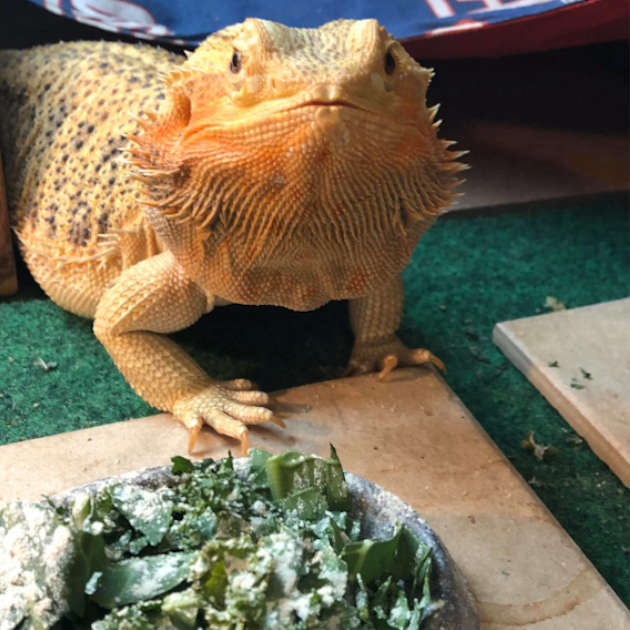
Is your bearded dragon not eating greens because it can’t see them? Beardies need to see the food to be attracted to it. Use shallow dishes. No need to buy anything expensive, your next dish could be from a secondhand shop for very little money.
Wide dishes are better where the food can be spread out. It is better that your bearded dragon takes time to eat than scoffing it all down quickly and having nothing else to do. Bearded dragons in the wild don’t have a bowl of food in one spot ready to eat.

Hack #7: Hang up those Veggies!
When a bearded dragon won’t eat greens try hanging them up! Some bearded dragons may show more interest in greens that are hanging down, and they can rip pieces off as they choose. As their tear pieces off the greens will move as well, hopefully bringing even more interest.
For this method, secure the greens by tying some string around the stems and hang them from the top of the enclosure. Your bearded dragon can then crop off mouthfuls that it can easily cope with.
This is similar to what they do in the wild except the leaves they pick at are on the ground and not hanging in the air.
Hack #8: Those Fresh Planted Greens look Pretty Good!
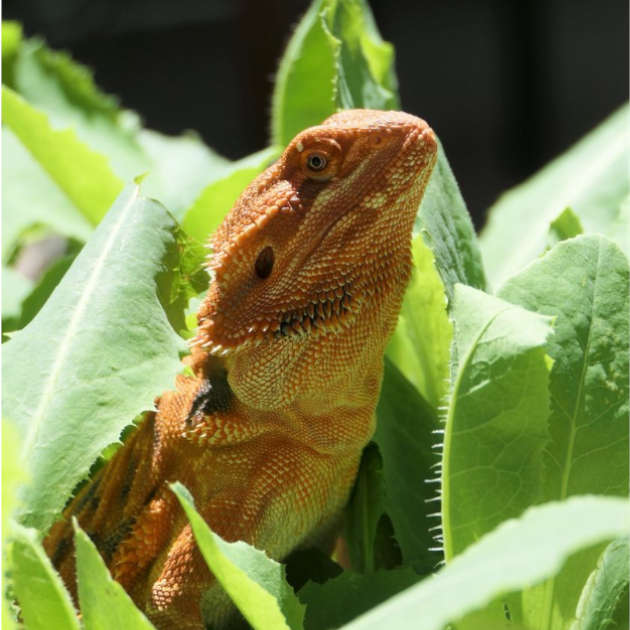
When a bearded dragon won’t eat greens try a more natural approach, let them graze. Offering your bearded dragon trays of live growing plants that you have specifically grown for them will let crop away at the greens they want to eat. This is particularly easy with plants such as clover, grass, dandelions, basil and other small edible plants.
Grow a dozen trays of vegetation to allow for rotation to save the plants, let them regenerate and to keep good hygiene. Clearly you don’t want to use chemical fertilizers, they will likely result in high levels of nitrates in the food. The frass (poop) from your insect colonies can make good natural fertilizer, talk about recycling!
If the opportunity exists, plant a garden so your pet bearded dragon can be taken out to choose its own veggies. The plants should be established enough to prevent them being pulled up by the root and subsequently eaten whole with any soil attached.
Variety remains the key in the long run and this method of providing food does provide an ideal source of fresh food and environmental enrichment.
Hack #9: Ok, let’s get to Hand Feeding
So, if your bearded dragon really won’t eat its greens and you have tried the other hacks, try hand feeding. It could just kick start your beardies interest when you wiggle it around in front of its face. Use feeding tongs to avoid getting tender fingers accidentally bitten.
Whole or part leaves can also be offered in this way. Using movement is the key here to get your beardies attention. If your bearded dragon takes a chunk out of your veggies, success!
Ensure your bearded dragon does not become dependent on hand feeding, there are too many downsides to that level of dependency for any animal.
Hack #10: You could be Feeding too much, too Often
No point beating around the bush, look at how much you are feeding and how often. Are you feeding too much of the other stuff… you know, insects? Is your bearded dragon a bit chunky? Could you be accidentally feeding too much of everything trying to be the kind loving human being that you are?
Under normal circumstances an adult beardie does not need a lot of food and they do not need to be fed every day. Having said that, there are times they do need more feed, such as when the females are gravid. In the post () we look at how much bearded dragons need to eat and how often.
Hack #11: Salad Dressings Anyone?
When a bearded dragon won’t eat greens it’s easy to turn to salad dressings. You could make your own salad dressing using some mashed up pumpkin, sweet potato, or perhaps some baby food with pumpkin or carrot. Experiment and see what your bearded dragon likes.
Not all Salad Dressings are a Good Thing. Naughty, Naughty!
Not all salad dressing are equal.
Fruit as a Salad Dressing
Let’s address the elephant in the room here, fruit. When a bearded dragon is not eating greens it is so easy to turn to fruit. Fruit dressings have helped many a bearded dragon not eating greens, but is it a good thing?
- Fruit for bearded dragons is not as healthy as we like to think. We humans think of fruits as a healthy snack, but modern cultivares are much higher in sugar and lower in fiber than the wild fruits animals naturally eat. For animals, these sugary, low-fiber fruits can disrupt essential nutrient balances, especially the calcium-to-phosphorus ratio that’s critical for bone health (Clauss & Hatt, 2011). Unlike the leafy greens they need, fruits simply don’t offer the right nutrients and fiber for optimal digestion and health.
- Fruits have been directly associated with dental disease. Check the Care section of the website for more details on bearded dragons teeth.
Commercial Reptile Salad Dressings
Then there are the commercial reptile salad dressings with various additives to enhance flavor, extend shelf life, and improve texture. The additives listed, such as sucrose, citric acid, xanthan gum, potassium sorbate, lycopene, and canthaxanthin, each serve specific purposes:
- Sucrose: A common sweetener derived from sugar cane or sugar beets. We need to stay away from the sugars. Again, moves into obesity, dental disease and other health issues.
- Citric Acid: Used as a preservative and to add a sour taste, citric acid is generally considered safe but citric acid can disrupt the digestive system of bearded dragons, potentially leading to gastrointestinal distress. Here is a list of foods bearded dragons cant eat.
- Potassium Sorbate: A preservative that inhibits the growth of mold, yeast, and fungi. While recognized as safe for human consumption, its effects on pets are less clear.
The inclusion of calcium lactate and vitamin D3 is significant. For bearded dragons, or any pet reptile, maintaining the correct balance of calcium and vitamin D3 is essential to prevent metabolic bone disease and other health issues. How do you know how much of any supplement you are feeding if you do not do it yourself with the right calcium powders. We have no idea how much calcium or other supplements they are getting by sprinkling on some salad dressing.
Over-supplementation can be just as harmful as deficiency, leading to issues such as hypercalcemia, which can cause kidney problems, calcification of soft tissues, and other health issues. If you are not sure what your reptile needs, then it is best to consult your vet at your next visit.
To understand this discrepancy, we have to remember that, for humans, fruit is usually better than other snack alternatives such as chocolate bars or biscuits. If humans wanted to live particularly healthy, they would eat green leafy vegetables rather than fruits as snacks – but we know intuitively that such recommendations would meet with little enthusiasm.
(Clauss & Hatt, 2011)
Nurturing Healthy Dietary Habits
When a bearded dragon won’t eat greens, start with checking lighting, heating and try to look at what is happening from your bearded dragons perspective. Patience truly is a virtue when it comes to stubbornness. As long as your beardie isn’t ill, or its too young or at a time of life that it really does need additional protein from the insects, then it is likely you simply need to be waiting out the changing time. Could take a couple of weeks and your bearded dragons diet can be on track.
Some Folks in the Community Asked the Same Question
Why won’t my Bearded Dragon Eat Greens?
ok so I’m running out of ideas to feed Mushu some greens, well it’s hard to feed him at this time of the year period XD so any ideas will be greatly appreciated but he is deadly afraid of raspberries and I think he believes that strawberries are poison or something XD
He wasn’t properly fed before I got him so there is a lot of things he will not touch or even look at.
What mixes do you guys use for your beardies? Chantal
Sharon: I tear up greens small, then put in bowl. Then I take a raw sweet potato and peel it and grate it over the greens. Once there’s enough, I then mush it all around till the greens are covered. He can’t resist the sweet potato and ends up eating greens cuz they are covered in it.
Elle: I buy spring mix with herbs at the grocery store and use that as my base then buy a different bundle of greens to go with it every week like watercress, Bok choy, and dandelion greens. There is some lettuce leaf in the spring mix but I only give that to them 3 times a week and usually pick the majority out. My guy loves baby peas, carrots as a treat, arugula, red bell peppers, green beans, blueberries and raspberries. I notice my dragons don’t like any food that is white, like bananas or apples. They like sweet potatoes and squash to. Both of mine will eat anything green but Luna wont touch anything red or orange and Orion does. Its weird. Orion loves anything I usually give him and Luna picks around certain things.
Crystal: Mix in some worms of your choice to provide movement and get ’em used to the fact that it is food.
Ian: have you tried putting 4 or so wax worms under the greens? Theory is that if the food is moving then the dragon will eat. Another is to try baby food, but make sure it is pure with no added sugar, salt, etc.
Bearded Dragon won’t Eat anything but Bugs!
I cant get my beardie to eat any greens or veggies or fruit, if it doesnt move he wont touch it. Any suggestions??????? Brad
Kathy: Mine wouldn’t Eat veggies. And then one day I literally took a handful of it is salad and threw it on the floor right next to him and he started eating at the act of throwing it from about, that seem to make it become alive I guess.
Amiel: Hand feeding worked like a bomb for me. And make the foods colourful. Mine seem to like orange and red stuff.
Georgia: I tricked Mushu by putting worms under the greens. He then got smart… So I started wiggling the greens in front of him… He took to that and found that he enjoyed them.
Bearded Dragon not Eating Greens!
Can someone please help me how do I get my guy to eat his greens I tried everything and also worms it’s been a hassle so if someone give me tips that would be great? Sean
Marietha: I’ve had the same problem with my 2. I didn’t give them food for 2 days, then I offered green beans and butternut. And only gave them insects twice a week. It did the trick for them, they’re eating vegies like there’s no tomorrow!
Dawn: I know our bearded dragons go crazy when you put squash baby food on their greens.
Alicia: Baby food as a “salad dressing” worked wonders on our picky eater. He loves the color and perhaps the flavor of Sweet Potatoes and Squash.
How Can I get my Bearded Dragon to Eat Vegetables?
How can i get my dragon to eat greens? I’ve had her for about month and all she eats is mealworms, and that’s only if I hand feed her. I’ve managed to trick her into eating a few locusts by putting worms on top of them but she outright refuses to eat greens of any variety. She’s 5, going on 6, and also very lazy. She’s asleep on my shoulder as i’m typing this! Her temps are fine and she’s just going into shed. She’s pooping normally too. any suggestions? Val
Meri: It took a long time and lots of patience to get Buddy to eat greens. We started by putting the bugs on top of the veggies.
Allyson: Mine got a little addicted to mealworms a while back. Two words: tough love. Gave mine nothing but greens and a couple crickets everyday till he started eating normally again and then cut back on mealworms after that.
Sharon: Tough love works! Stop giving worms only salad for a few days. She won’t starve.when she gets hungry enough she will eat. I did it with my guy it works. Now I give him salad first in the morning then feed bugs later.
FAQs
Why won’t my bearded dragon eat greens?
Bearded dragons may refuse vegetables because they have taste preferences like humans for other things. Insects are usually the preference along with sugary foods like fruit. Being too young, stress, illness, brumation and inadequate temperatures or lighting can also affect their appetite.
What to do if bearded dragon won’t eat greens?
If your bearded dragon won’t eat greens try varying their diet, changing the look of the food, try different techniques of offering food, check the heating and lighting, look for dental disease and animate the food with live insects.
References
Clauss, M., & Hatt, J-M. (2011) Green grocery guide. Zooquaria. European Association of Zoos and Acquaria. Issue 5
Fukunaga, A., Uematsu, H., & Sugimoto, K. (2005). Influences of Aging on Taste Perception and Oral Somatic Sensation. The Journals of Gerontology Series A: Biological Sciences and Medical Sciences, 60(1), 109–113.
Gimmel, A., Kempf, H., Öfner, S., Müller, D., & Liesegang, A. (2017). Cholelithiasis in adult bearded dragons: retrospective study of nine adult bearded dragons (Pogona vitticeps ) with cholelithiasis between 2013 and 2015 in southern Germany. Journal of Animal Physiology and Animal Nutrition, 101, 122–126.
Wotherspoon, A. D. (2007). Ecology and management of Eastern bearded dragon : Pogona barbata.
FAQs
Why won’t my bearded dragon eat vegetables?
A bearded dragons may not eat vegetables for various reasons including incorrect lighting which they need to see the food the way they need to, could be stress, brumation setting in, dental disease, too many bugs in the diet and other things that can affect their appetite. Inadequate temperatures in their habitat may also impact digestion and eating.
What to do if bearded dragon won’t eat greens?
If your bearded dragon won’t eat greens try varying their diet, changing the look of the food, different techniques of offering food, check the heating and lighting, look for dental disease and animate the food with live insects.


