Getting calcium for bearded dragons right can get a little confusing, especially when adding vitamin D3 into the equation. This essential guide to simplifying calcium for bearded dragons will get you on track to keeping your beardie healthy.
Dr Amna Ahmad is a Doctor of Veterinary Science graduated from the University of Agriculture, Faisalabad, Pakistan.
Read more…
Bearded Dragons Calcium in the Meal Plan
1. How Often do Bearded Dragons Need Calcium?
The frequency of providing calcium for bearded dragons changes with age. The recommendation of numerous veterinarians, researchers and herpetologists is as follows:
| Stage | Supplementation Frequency | References |
| Neonates – Hatchlings | 4-5 times a week | Daily (Laferber Vet, n.d.) |
| Juvenile | Every 2nd day | All foods every 2nd day (Doneley, 2006; Cannon, 2003; (West Toowoomba Veterinary Surgery, 2018) |
| Adult | Once a week | Once weekly (Doneley, 2006; Cannon, 2003; (Rich et al., 2017; (West Toowoomba Veterinary Surgery, 2018; Laferber Vet, n.d.) or Dust insects 2-3 times a week (Lock, 2017) |
| Reproductively active females | Every 2nd day | Same as juveniles (Wright, 2008) |
Supplementation of calcium for bearded dragons given access to unfiltered sunlight will be less than those receiving artificial UVB light. Take your bearded dragon outdoors in the sunlight often!
2. Bearded Dragons Calcium Powder: How Much is Enough?
When giving a bearded dragon calcium powder, there is a tiny bit of guesswork as there are so many variables involved. For example, it could be a young growing beardie or gravid, perhaps their diet has them eating more phosphorus than calcium, or a few too many oxalates.
Assuming you are using human grade calcium carbonate (40% calcium) then the amount of calcium powder a bearded dragons need is as little as a pinch of calcium (1/16th of a teaspoon or approximately 0.835 mg). Vetark have brought their measures down to ‘pinches’ to make it easy however, using human grade calcium is ideal.
Just to give you context, for iguanas, 1 full pinch of calcium per 2lbs of body weight is recommended (Mader, 2006). Based on 1 pinch of calcium carbonate being around 0.835 mg, the equivalent for a bearded dragon weighing 300 gram (0.66 lb) would be 0.33 of a pinch or 275 mg. This is below the calcium recommendation for bearded dragons but still demonstrates that it doesn’t take a lot of supplement, just needs to be given regularly.
The amount of calcium fed to bearded dragons stays the same, but the frequency will increase with variables such as the biological stage of the animal (e.g. a gravid bearded dragon needs more frequent doses of calcium).
If you are feeding your bearded dragon 50% or more of the total diet with commercially prepared diets, supplementation should not be required (Stahl and Donoghue 2010) or at least reduced to prevent over supplementation. Check the ingredients of the food before supplementing and speak with your vet for guidance.
A phosphorus-free calcium supplement with Vitamin D3 should also be sprinkled on the feeder insects and vegetables immediately prior to presentation.
Raiti (2012)
3. Calcium and Phosphorus Balance (Ca:P)
Getting the calcium for bearded dragons just right isn’t only about how much they get, but also about the balance with phosphorus in their diet. Think of it like a seesaw: you want to keep it balanced for your bearded dragon to grow strong and healthy.
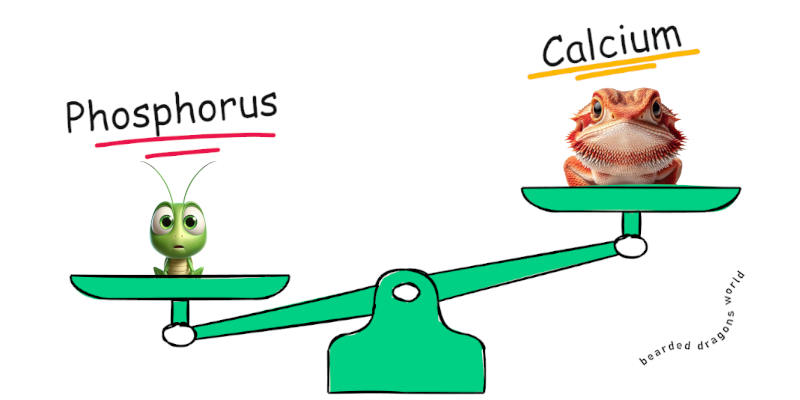
Why the Balance Matters:
- For Growing Bearded Dragons: They need more calcium, so aim for a calcium to phosphorus ratio of 2:1 (Girling, 2013). This helps them build strong bones.
- Adult Bearded Dragons: Their needs are a bit less, with a good balance being around 1.5:1 (Girling, 2013).
- Egg-Laying Females: They need a lot more calcium, so their ratio can go all the way up to 10:1 during these times to support egg development (Girling, 2013).
Getting the right ratio of calcium for bearded dragons aids in their overall health.
4. Phosphorus impacts Bearded Dragon Calcium Levels
While certain foods are rich in phosphorus or contain compounds that may hinder calcium absorption, this doesn’t mean they should be entirely excluded from the diet as they may offer other nutritional benefits.
However, feeding foods high in phosphorus like mice, muscle meat, cat food, dog food and other meats is unnecessary and pose more risks than benefit.
Vegetables high in phosphorus such as pumpkin seeds, pea sprouts, celery and peas may be managed with treatment which we go through in the article on freezing and bulk meal preparing. Of course the main way to manage overdoing any antinutrient is to offer a wide variety of foods.
The ratio of calcium to phosphorus is important – as one increases, the other decreases and vice versa.
Girling (2013)
5. Calcium Rich Foods
Adding a range of foods high in calcium to your bearded dragon’s diet sounds great so, below are some foods that are a list of food high calcium.
- Alfalfa
- Cilantro
- Collard Greens
- Dandelion Greens
- Endive/Chicory
- Escarole
- Mulberry Leaves
- Mustard Greens
- Parsley
- Romaine Lettuce
- Turnip Greens
- Watercress
The issue with this approach is that each plant has its own set of nutrients and antinutrients. Isolating one plant as good in one particular nutrient is not effective at creating a balanced and varied diet.
For example, alfalfa is high in calcium and can be well received by a bearded dragon. On the other hand, it contains saponins and oxalates. Collard greens have goitrogens and dandelion greens are high in potassium. Parsley has high oxalates, it has nitrates and its high in vitamin A, which isn’t good in high doses for bearded dragons. But don’t get discouraged on antinutrients. The post on Bearded Dragons Eat Frozen goes through how to reduce antinutrients and help you balance out the good nutrients a bit more.
6. Foods that can Block Bearded Dragon Calcium Absorption
Foods high in oxalates and phytates have the potential to inhibit the uptake of calcium.
Oxalic and phytic acids bind to calcium making it unavailable. However, these foods can be added in small portions occasionally to a healthy bearded dragons diet (Stahl and Donoghue, 2010; Boyer, 2021). If they are fed, feed in small portions alternating with other foods.
Broccoli, kale and Bok Choy are examples of foods rich in calcium but also have high oxalate and goitrogen that is often claimed to negatively affect their nutritional importance.
For details on antinutrients and toxic foods see the post on What Bearded Dragons Can’t Eat.
7. Bearded Dragons Calcium Optimization: Diet vs Environment
Providing adequate calcium for bearded dragons involves more than just dietary supplementation; it requires a holistic approach that includes proper UVB lighting, temperature regulation to mimic natural basking conditions, and possibly even probiotic supplementation to support gut health and mineralization. These factors together ensure the optimal health and well-being of bearded dragons, highlighting the intricate interplay between diet, environment, and physiology in reptile care.
Here are some practices to adjust to improve absorption of calcium for bearded dragons uptake:
- Gut Loading and Dusting: Increase the calcium content of feeder insects by gut loading them with calcium-rich foods and dusting them with calcium powder. Soldier fly larvae are especially beneficial due to their naturally higher calcium to phosphorus (Ca:P) ratio (Divers, 2018).
- Hydration: Keep your bearded dragon well-hydrated. Adequate water intake supports nutrient absorption, digestion, and waste elimination.
- UVB Light & Heat: Provide proper UVB light and heat, preferably including outdoor exposure to sun and heat within the care regime.
Perhaps the most widely accepted method of raising the calcium content is to “dust” these food items with calcium powder; however, feeding the insects a high calcium diet for 24 hours or more before feeding them to a reptile has been shown to be much more efficient at providing the needed calcium to the reptile.
Mader (2006)
Forms of Calcium Supplements for Bearded Dragons
When choosing the best calcium supplements for bearded dragons the winner has to be the most biologically available and effective option.
In case you don’t want to read all about it but just want a straight answer, the best calcium for bearded dragons are calcium carbonate and calcium citrate. But its not that simple, read on for the detail.
Products marketed specifically for reptiles don’t have the same controls that supplements for humans have. Calcium supplements manufactured for human consumption have tighter quality controls. For this reason Klaphake (2010) recommends using calcium supplements for bearded dragons that were meant for human use.
1. Best Bearded Dragon Calcium Powder
Powdered calcium is the most common form of supplement for bearded dragons and is widely recommended by veterinarians and reptile enthusiasts. It’s dusted over insects, eaten by insects in gut loading, sometimes dusting vegetables, ensuring your bearded dragon receives calcium with their regular meals.
1.1. Calcium Carbonate Powder
Calcium carbonate is the most common and recommended calcium supplement for bearded dragons and is certainly the choice of DVM Thomas Boyer (2021).
It’s widely available, cost-effective, and highly absorbable, making it the best choice for most reptiles.
Calcium carbonate is approximately 40% elemental calcium, and its bioavailability makes it particularly effective for calcium supplementation. But calcium carbonate requires stomach acid to absorb. According to Corliss (2020) some humans can complain of mild constipation and bloating when using calcium carbonate.
Always choose products without cholecalciferol (vitamin D3) and phosphorus. Bearded dragons get plenty enough phosphorus, and it would though out the balance of Ca:P. Only buy calcium with vitamin D3 if your bearded dragon is getting insufficient UVB. Bit of sunshine would fix that up!
Pros:
- Easy to control dosage by adjusting the amount of powder used.
- Long shelf life and does not require refrigeration.
- Ensures that calcium is directly ingested with food.
Cons: n/a
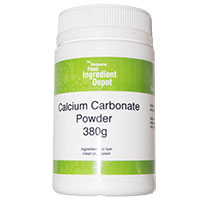
Simple and cheap powdered calcium carbonate is one of the best forms of calcium for bearded dragons. Calcium carbonate powders can be purchased from health food shops.
1.2. Calcium Citrate
Calcium citrate is one of the most bioavailable forms of calcium for bearded dragons. It is more easily absorbed compared to calcium carbonate, especially in reptiles with lower stomach acidity.
Calcium citrate is less concentrated in elemental calcium (about 21%) compared to calcium carbonate which means you would need more of it. (Klaphake, 2010). However, in humans, it is more easily absorbed than calcium carbonate and it can be taken without food (Corliss, 2020).
Pros:
- It can be taken without food and is less dependent on stomach acidity for absorption but then under normal circumstances, bearded dragon calcium is issued with food.
- Less likely to cause gastrointestinal issues like constipation or gas.
Cons:
- More expensive than calcium carbonate.
- Requires a higher dosage to achieve the same level of calcium supplementation.
1.3. Calcium Lactate & Gluconate
Calcium lactate and gluconate are more highly bioavailable forms of calcium with similar absorption rates to calcium carbonate. These forms of calcium are only 13% calcium and 9% calcium respectively (Feldman, 2015) which makes it much more difficult to use simply because of how much you need.
Pros:
- Similar absorption to calcium carbonate.
- Can be used if calcium carbonate causes digestive issues.
Cons:
- With a low concentration of calcium a much higher dose is needed.
2. Liquid Calcium for Bearded Dragons and How to Use It
Liquid calcium supplements can be easy to administer but it is probably not the best option. Sprays intended to give bearded dragons calcium have been found to be lacking in sufficient calcium with some as low as 1700ppm which is equal to 0.17% (Boyer, 2021).
To use liquid calcium with bearded dragons, give it to them directly in their mouth with a small eye dropper. Do not put liquid calcium in a bearded dragons water. It will change the flavor of the water and you cannot manage how much calcium your bearded dragon is getting.
2.1 Calcium Glubionate
Calcium glubionate is a liquid form of calcium often used for reptiles that require immediate supplementation, particularly in cases of metabolic bone disease (MBD) (Klaphake, 2010). Calcium glubionate has about 6.6% elemental calcium (The Food State Company, 2024).
Pros:
- Easy to administer in liquid form, making it ideal for reptiles that have difficulty eating.
- Useful for emergency situations where rapid calcium supplementation is needed.
Cons:
- Less concentrated, requiring larger volumes for adequate supplementation.
- More expensive and may not be practical for long-term use.
- It needs to be refrigerated.
- Has a shorter shelf life than powders.
3. Animal Forms of Calcium for Bearded Dragons
3.1. Bearded Dragon Calcium as Meal Bone
A pinch of bone meal powder may be a good source of calcium for bearded dragons however, but its risk of being contaminated with lead is too high.
Pros:
- Bone meal is an excellent source of calcium.
- It can easily be sprinkled over insects and vegetables, making it a convenient way to add calcium to your bearded dragon’s diet.
- Being derived from bones, it is a natural source of calcium, potentially offering other micronutrients.
Cons:
- Bone meal can contain lead (Corliss, 2020) and there are no safe levels of lead exposure.
- Not all bone meal products are created equally or with reptiles in mind. Make sure the product is free from harmful additives and is safe for reptile consumption.
- Some bearded dragons might find bone meal-dusted food less appealing, which could affect their willingness to eat.
Avoid products made from unrefined oyster shell, bone meal, dolomite, or coral, as they may contain lead or other toxic metals.
(Corliss, 2020)
3.2. Cuttlefish
Cuttlebone, composed mainly of aragonite, is a natural calcium source. To make it suitable for bearded dragons, it should ideally be ground into a fine powder for easier digestion.
For the calcium from cuttlebone to be effectively utilized, it needs to be in powdered form. According to Dr. Boyer (2021), observations have shown that when cuttlebone is fed to tortoises in chunks, it passes through their digestive system, appearing whole in their feces. To ensure a more precise intake of calcium and enhance the likelihood of absorption, it is advisable to use calcium carbonate powder instead.
An alternative method of utilizing cuttlebone as a powder is to place it in your bearded dragons water dish. As it gradually dissolves, it releases calcium.
But cuttlebone is not the best form of calcium for bearded dragons as there are too many drawbacks.
Pros:
- Natural calcium source that can provide micronutrients.
- Readily available and relatively inexpensive.
Cons:
- Must be powdered for effective use or placed in water.
- It is impossible to manage how much calcium is being consumed which leads to dangers.
Best Way to Give Calcium Supplements to Bearded Dragons
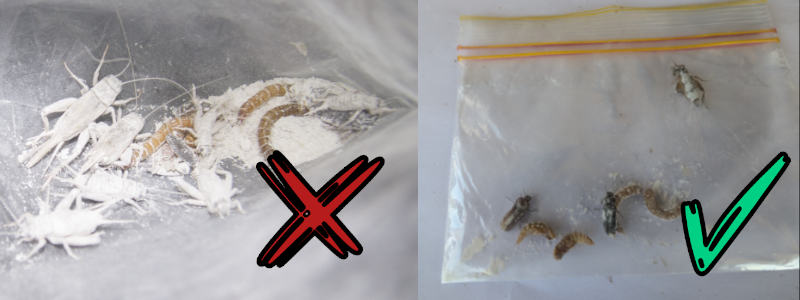
Sprinkle some calcium powder on insects. Just a pinch can be enough. There are a series of posts on the nutritional value of insects and how to improve them which gives details on the specific insect. For example, the post on mealworms covers how much calcium to gut load and dust them with. Excessive calcium can be unpalatable. Foods dusted with too much calcium will probably be refused.
Can you put Calcium in Bearded Dragons Water?
Yes, you can put calcium for bearded dragons in their water but it is not good practice.
Calcium powder doesn’t dissolve well in water, which can lead to inconsistent dosages and potentially inadequate calcium intake or too much calcium. Instead, direct supplementation by dusting their food with calcium powder is recommended to ensure that your bearded dragon receives the proper amount of calcium.
Vitamin and mineral supplements administered in the water will allow rapid bacterial growth over 24 hours, so bowl hygiene must be rigorous.
Girling (2013)
How do Bearded Dragons get Calcium in the Wild?
So, if they need supplementing then how do bearded dragons get calcium in the wild? Bearded dragons get calcium in the wild from their food and their amazing ability to make use of very little by converting UVB radiation (sunlight) into vitamin D3. In the wild, this aids them in being able to use calcium efficiently. In addition, bearded dragons access a wide range of foods in the wild not possible to replicate in captivity.
| Aspect | In the Wild | In Captivity |
| UVB Exposure | Direct sunlight converts to D3 | Limited; relies on artificial UVB |
| Natural Diet | Degraded bone, snail shells | Requires supplemented calcium |
| Vitamin D3 Production | High due to ample sunlight | Reduced; needs supplementation |
Natural Sources Calcium for Bearded Dragons in the Wild
A study by Oonincx et al. (2015) analyzed the stomach contents of ten wild Pogona vitticeps, revealing a small amount (2.3%) of indigestible material, including bits of degraded bone. It was suggested that these fragments could contribute to the bearded dragons’ calcium intake in their natural habitat.
Further investigations, such as those noted by Baines (2017), indicate that bearded dragons might also derive calcium from other natural elements like dried bones, snail shells, and possibly even chalky rock dust. These findings shed light on the diverse ways bearded dragons can fulfill their calcium needs in the wild.
Bearded Dragon Vitamin D3: The Sunshine Vitamin
Bearded dragons need Vitamin D3 to metabolize and absorb calcium. The body cannot use calcium unless it has vitamin D3. However, Vitamin D3 can be overdosed.
The best source of vitamin D3 is good old sunshine, and it is the safest too. UVB rays from the sun or a UVB bulb help your dragon produce Vitamin D3 naturally. If you do not take your bearded dragon outdoors, you’ll need to make sure their UVB lighting is up to par.
The requirements of D3 for reptiles are poorly understood and carries risks since safe levels are not known (Boyer, 2021). D3 is normally fed to nocturnal reptiles that do not have exposure to UVB lights. More on this in the post ().
Can you give a Bearded Dragon too much Calcium?
Yes you can give a bearded dragon too much calcium. Overdosing on calcium, particularly when combined with high levels of vitamin D3, can lead to health issues.
- The Right Amount: Calcium is essential for your bearded dragon’s health, but balance is key.
- Vitamin D3 Role: It helps in the absorption of calcium but needs to be in harmony with calcium levels.
What Happens if a Bearded Dragon has too Much Calcium?
Common causes of overdose:
- Excessive Supplements: Both UVB exposure and oral supplements of vitamin D3 need to be regulated.
- Improper Lighting: Artificial UVB lighting must be carefully managed to prevent overexposure.
If a bearded dragon has too much calcium it could result in hypercalceia and interfere with nutrient uptake.
- Hypercalcemia: An excess of calcium in the bloodstream, potentially harmful or even fatal.
- Nutrient Interference: Too much calcium can disrupt the absorption of other vital nutrients.
- Physical Symptoms: Including changes in bone density, muscle issues, and overall discomfort.
| Sign | What It Means |
|---|---|
| Lethargy | Your dragon is less active than usual. |
| Muscle Weakness | Moving seems harder for them. |
| Constipation | Their digestion is off. |
To prevent overdosing a bearded dragon with calcium:
- Monitor Vitamin D3 Levels: Ensure a balanced intake to aid calcium absorption without excess.
- Optimize UVB Lighting: Set up their habitat to mimic natural conditions, providing areas to bask and hide.
- Dietary Management: Adjust how much calcium is provided if other foods include calcium in their ingredients such as commercial foods.
References
- Barboza, T., & Bercier, M. (2024). An Update on Companion Inland Bearded Dragon (Pogona vitticeps) Nutrition. Veterinary Clinics of North America: Exotic Animal Practice, 27(1), 71–84. https://doi.org/10.1016/j.cvex.2023.08.002
- Boyer, T. H. B., DVM, DABVP (Reptile and Amphibian. (2021, November 3). Reptile and Amphibian Nutrition. LafeberVet.
- Curriculum and Reform. (2024). Inland Bearded Dragon – nutrition and water. NSW Government – Education. https://education.nsw.gov.au/teaching-and-learning/animals-in-schools/animals-in-schools-species/australian-native-animals/inland-bearded-dragon/inland-bearded-dragon-nutrition-and-water
- Divers, S. J., and Stahl, S. J. (2018) Mader’s Reptile and Amphibian Medicine and Surgery- E-Book. Elsevier Health Sciences.
- Donoghue, S., & McKeown, S. (1999). Nutrition of Captive Reptiles. Veterinary Clinics of North America: Exotic Animal Practice, 2(1), 69–91.
- Frye, F. L. (1984). Nutritional Disorders in Reptiles. Diseases of Amphibians and Reptiles, 633–660.
- Girling S. J. (2013) Reptile and amphibian nutrition. In: Girling SJ, editor. Veterinary nursing of exotic pets. Oxford: Blackwell Publishing. p. 286–96.
- Girling, S. J. (2013). Veterinary Nursing of Exotic Pets (2nd ed.). Wiley.
- Klaphake, E. (2010). A fresh look at metabolic bone diseases in reptiles and amphibians. Veterinary Clinics: Exotic Animal Practice. 13(3), 375-392.
- Mader, D. R. (2006). Reptile medicine and surgery (2nd ed.). Saunders Elsevier.
- Oonincx, D. G. A. B., Leeuwen, J. P. van., Hendriks, W. H., Poel, A. F. B. van der. (2015) The Diet of Free-Roaming Australian Central Bearded Dragons (Pogona vitticeps). Zoo Biology 34:271-277. Wiley Periodicals Inc.
- Parkinson, L. A., & Mans, C. (2018). Effects of furosemide administration to water-deprived inland bearded dragons (Pogona vitticeps). American Journal of Veterinary Research, 79(11), 1204–1208.
- Raiti, P. (2012) Husbandry, Diseases, and Veterinary Care of the Bearded Dragon (Pogona vitticeps). Journal of Herpetological Medicine and Surgery. 22(3-4):117-131
- Stahl, S. J. (1999). General Husbandry and Captive Propagation of Bearded Dragons, Pogona vitticeps. Bulletin of the Association of Reptilian and Amphibian Veterinarians, 9(4), 12–17.
- Stahl, S., & Donoghue, S. (2010). Small animal clinical nutrition: Vol. Chapter 71 (M. S. Hand & L. D. Lewis, Eds.; pp. 1237–1254). Mark Morris Institute